Wednesday, January 15, 2014
Reasons 'Why': The Price of Gold
Before she became a villain in one of sports' weirdest scandals, Tonya Harding was figure skating's ugly duckling. Raised in Oregon by a physically and emotionally abusive mother, she was a skater who came from modest means and looked like it. Acted like it, too. Competing in a sport that celebrates elegance and finesse, Harding was rough and tumble. In The Price of Gold, the latest in ESPN Films' "30 for 30" series, Harding is described as coming from the "gutter." She's compared to an "alley cat" and called a "trailer trash ignoramus." Eventually, even Harding gets in on it, noting that the media portrayed her as a "piece of crap" juxtaposed against skating's "princess," Nancy Kerrigan. If life were a Hans Christian Andersen fairy tale, Harding would have gone to the Olympics in Lillehammer, skated up to her incredible potential, won gold and transformed into a swan in front of our eyes. And maybe then Harding would have liked the sight of her own reflection. Alas, Harding's fairy tale was destined to be Grimm. So instead, the ugly duckling got together with some loons and decided to disfigure the prettiest swan on the pond.
Even in retrospect the Harding-Kerrigan melodrama is stranger than fiction, except that all the players seemed straight out of central casting. The tomboyish, insecure blonde who honed her skills at a shopping mall skating rink. The pretty, poised brunette with the endorsement deals and the (misleading) air of privilege. The scheming husband, with the dark eyes and the mustache almost long enough to twirl. The goon accomplices who looked like they could get lost in a phone booth, assuming they could figure out how to get inside one. All of them came together under the bright spotlight of the pre-Internet Era Winter Olympics. Director Nanette Burstein (American Teen) recounts the events of 1994 with impressive clarity and pace, chronicling not just what happened but the media's frenzied reaction to it, because indeed that was a distinct element of this tabloid-worthy scandal right from the start. Those too young to remember the whack heard round the world will come away with a clear understanding of how it all unfolded. But what's most impressive about The Price of Gold is that it's more than a transcript. It looks beyond the highlights and lowlights to try to understand why.
Sunday, January 12, 2014
Coulda Been a Contenda: No Mas
Roberto Duran stunned boxing fans when he put a beating on then welterweight champion Sugar Ray Leonard in their first meeting, "The Brawl in Montreal," June 20, 1980. But that was nothing compared to the shock he provided in their second meeting five months later. In the eighth round, after exchanging a few blows with Leonard, Duran traded hooks and jabs for a move that most in boxing had never seen before: he waved his right glove in surrender. "No mas," he said. No more. One of the most ferocious fighters the sport had ever seen — Joe Frazier said Duran reminded him of Charles Manson — up and quit. The crowd at the Superdome in New Orleans and those watching live on TVs around the world were flabbergasted. From his ringside microphone, legendary broadcaster Howard Cosell summed it up as it unfolded, calling it "the most inexplicable thing I have ever seen in the ring."
The "No Mas" fight transcended sports and instantly became part of the pop culture. (You didn't need to be able to pick Roberto Duran out of a lineup in order to understand a "no mas" joke.) The TV footage was boxing's version of the Zapruder film, with the outcome unmistakable and the cause shrouded in mystery. Why did Duran quit? Did he have stomach cramps, as he insisted after the fight but showed no signs of up until his surrender? Was he out of shape? Had he simply had enough of Leonard's showboating antics? These questions have never been satisfactorily answered. And for all of these reasons, the "No Mas" fight is perfect fodder for ESPN Films' "30 for 30" franchise. But like many boxing bouts, No Mas fails to live up to its self-created hype.
Sunday, March 17, 2013
This Time With Meaning: Survive and Advance

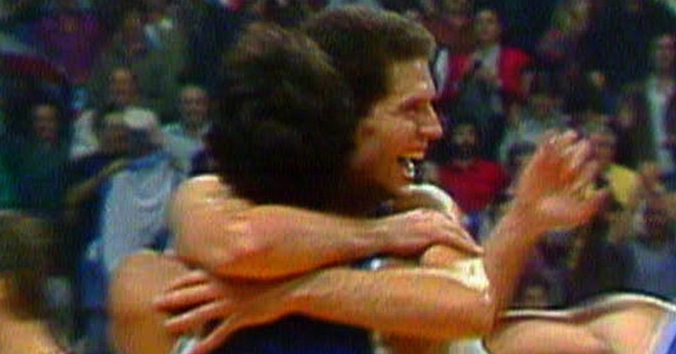
Dereck Whittenburg receives the awkward one-handed fling from Thurl Bailey less like the targeted shooter in the closing seconds of a national championship basketball game than like a defensive back intercepting a wayward pass before it sails into the bleachers. From nearer to half court than the 3-point arc, Whittenburg gathers the ball, turns, takes a deep knee bend and fires. It's a moon shot, and at the very moment it becomes obvious that the ball won't reach the rim Lorenzo Charles leaps into the frame, collects the ball near the iron and drops it into the hoop as time expires, giving North Carolina State a 54-52 upset victory over the University of Houston and sending the Wolfpack's flamboyant head coach Jim Valvano running around on the court looking for someone to hug.
It's one of the most famous sequences in college basketball history — memorable because NC State wasn't supposed to have a chance against Houston in that 1983 NCAA championship, memorable because Valvano's reaction reveals both his shock and his spirit, memorable because the game-winning bucket and Valvano's reaction are so charmingly inelegant and, last but not least, memorable because CBS and ESPN play the hell out of that highlight clip each March. If you're even a little bit of a college basketball fan, you've seen that play at least a dozen times. It's the quintessential March Madness moment and it's something of an eternal flame for Valvano, the beloved coach, broadcaster and motivational speaker. That said, the ubiquity of the NC State upset highlight is the very thing that made me skeptical about Survive and Advance, the latest edition of ESPN Films' "30 for 30" series, which seeks to climax with a sports moment that is as worn from overuse as a child's favorite toy. In the original "30 for 30" volume, director Jonathan Hock did a marvelous job reviving the forgotten legend of Marcus Dupree, but I wondered if he could be as successful crafting drama and insight from a story that is already so familiar.
Turns out, he was ready.
Tuesday, October 30, 2012
Old Times They Are Not Forgotten: Ghosts of Ole Miss
"What is the cost of knowing our past? What is the cost of not?" That's the quandary driving Ghosts of Ole Miss, the latest entry in ESPN Films' "30 for 30" series, which pokes at a 50-year-old wound that for many Mississippians has never quite healed. Back in 1962, the University of Mississippi's first black student enrolled on campus, flanked by military escorts, in peaceful defiance of a violent revolt by the university's student body, and others within the community. On the night of September 30, 1962, James Meredith slept peacefully in a dorm room as Mississippians protesting his admittance clashed with the hundreds of U.S. Marshals and military police sent by President John F. Kennedy and Attorney General Robert F. Kennedy to protect his constitutional rights. Guns were fired. Molotov cocktails were thrown. More than 200 were injured and two died. It was the darkest day in the history of Ole Miss — a day many who lived through it would like to forget. And yet it happened in the same year that Ole Miss' football team turned in a season to remember, going 10-0, winning the Sugar Bowl, and missing a chance at the national title perhaps only because the university's reputation had been sullied by the campus violence.
Tuesday, October 23, 2012
Tragically Familiar: Benji
If Benji feels like a tour of familiar territory for ESPN Films' "30 for 30" franchise, there's a reason. Chronicling the short life and premature death of 1980s Chicago basketball prospect Ben Wilson, this documentary by Coodie (Simmons) and Chike (Ozah) is yet another tale of unrealized potential and dreams unfulfilled — a theme covered in basketball flicks Without Bias (on Len Bias) and Guru of Go (which while ostensibly about Paul Westhead is memorable for its inclusion of Hank Gathers), plus The Best There Never Was (on football player Marcus Dupree) and, to a lesser extent, Tim Richmond: To the Limit. Benji also fits right in with the "What if I told you ...?" theme of the "30 for 30" marketing campaign, bringing to light a sports story that's unforgettable for those who experienced it and yet all too easy for the rest of us to overlook (Into the Wind might be my favorite example of that subgenre, but you could argue that at least a quarter of the "30 for 30" series is in that vein). But if Benji doesn't do much to stand out, we shouldn't think less of it for fitting in. Last week's release, There's No Place Like Home, was, in its utter disastrousness, a reminder of this series' routine excellence. And at least from journalistic perspective, it's far less important for Benji to stand out amongst its peers than for the documentary to prove that Ben Wilson stood out amongst his.
Tuesday, October 16, 2012
Sympathy for the Blue Devils: There's No Place Like Home
It might have worked as a short. ESPN Films has released two of them so far in its "30 for 30" spinoff series. The first, on Pete Rose's life as a memorabilia peddler, is just under eight minutes long. The second, on Arnold Schwarzenegger's quest to be a body builder, runs just over 12 minutes. Split the difference, cut the fluff, and maybe There's No Place Like Home could have been a light yet agreeable 10-minute documentary. But at an hour it's a disaster. Monotonous. Artificial. Utterly irritating. Previously, the low point in the "30 for 30" feature series was Little Big Men, and it wasn't close, but There's No Place Like Home is in a class all its own, reaching depths you figured the series could go 10 years without nearing. True enough, the "30 for 30" series includes so many good-to-great installments that it's tough to impress — even incredibly strong pictures like Tim Richmond: To the Limit get lost in the shuffle. But with those high standards comes a reputation worth protecting, and seeing this documentary added to the proud "30 for 30" library is like watching an over-the-hill Muhammad Ali or Mike Tyson climb into the ring for another paycheck. I didn't even reach the 10-minute mark before wishing that someone could ring the bell and stop the bleeding.
Tuesday, October 9, 2012
Seeing is Disbelieving: 9.79*
When sprinter Usain Bolt won the gold medal in the 100-meter dash at the 2008 Olympics in Beijing, we were shocked but not surprised. Bolt's time of 9.69 was otherworldly, and he achieved it despite decelerating with at least a quarter of the race remaining, which was mind-blowing, but world-record dominance was exactly what we were expecting from the charismatic Jamaican. Technically, there were seven other entrants in the "race" that night, but we knew it would be a one-man event, and it was. At the midway point, Bolt separated himself from the field as if his opponents had been slammed by a gale-force headwind; a few meters later, Bolt glanced over his shoulder as if wondering where everyone had gone. It was a dominating performance like no other — because previously no one had run under 9.72 — and yet something about it was familiar. Twenty years earlier, the same event was won in similarly dominating fashion by Canadian sprinter Ben Johnson, who bested the world record by four hundredths of a second while leaving his competitors in the dust in 9.79 — a time only seven men have matched since. Bolt's victory in Beijing launched him toward superstardom, but Johnson's inspired what might be the biggest controversy in Olympics history, bringing performance enhancing drugs (PEDs) into the spotlight like never before.
Daniel Gordon's documentary 9.79* rediscovers and further explores that controversy through interviews with its key players, including Johnson, runner-up turned winner Carl Lewis and the other six members of the 100-meter final that day. In memory, Johnson is the villain, the guy who tested positive for PEDs and lost his gold medal by disqualification, the guy who appeared on the cover of Sports Illustrated next to a headline reading "Busted" and the guy who eventually was banned for the sport for another failed test. But in hindsight Johnson is the guy who got caught doing what almost everyone else was doing, the guy who knowingly cheated but also might have been set up and the proverbial canary in the coalmine tipping us to a much larger problem that, in many respects, we are still too romantic or timid to confront. If the subsequent PED scandals in baseball and cycling weren't enough to make you see Johnson a bit differently, consider this: all but two of the entrants in that 1988 final wound up implicated in drug use down the road. Gordon's documentary, the latest release in ESPN Films' "30 for 30" series, doesn't apologize for Johnson's sins, nor does it praise him for his subsequent accountability, a la John Singleton's regrettable portrayal of Marion Jones in the 2010 "30 for 30" doc Press Pause. Instead, Gordon's doc makes it clear that Johnson almost certainly wasn't only cheater in that 100 final in Seoul. He was just the fastest.
Tuesday, October 2, 2012
Mo Money, Mo Problems: Broke
If you follow baseball even slightly, you've probably heard about a little controversy we've had here in Washington, DC, about the shutdown of Stephen Strasburg. If you're unfamiliar, the gist is this: The Washington Nationals went into the season planning to cap their stud pitcher's workload around 170 innings, because Strasburg is coming off a significant arm injury and the Nats felt that by limiting his output they could reduce the risk of repeat injury sometime in the future. For a developing franchise, this was a no-brainer, but then the Nationals had the audacity to become a very good baseball team much faster than many expected, and suddenly the Strasburg Patience Plan meant that the Nats would be voluntarily benching one of their best players when the games mattered most. Opinion spewers across the country lined up to suggest that the Nationals were foolish: Strasburg wanted to continue pitching and professed to have no discomfort in his arm, so why sit him? The answer, of course, is that all injured athletes have something in common: before they get hurt, they feel healthy. The Nats took the ball out of Strasburg's hand precisely because he wanted to continue pitching, and almost certainly would have done so until the season ended or his arm fell off - damn the long-term risks. The Nats stepped in because they had evidence to suggest that doing so was in Strasburg's best interest in the big picture, and thus also theirs. In short, the club saved Strasburg from himself, thinking about tomorrow for a guy with competition-induced myopia for today.
All of that is the long away around to discussing Broke, the first release in ESPN Films' second official volume of "30 for 30" documentaries. Broke isn't about Strasburg, or players coming off major injuries, but it is about professional athletes, convinced of their invincibility, taking short-sighted risks because they fail to appreciate the potential ramifications of those risks on the rest of their lives (no doubt in part because they lack a true appreciation for the vastness of "the rest of their lives" and because they refuse to accept that "the rest of their lives" is far more likely to start tomorrow than 10 years down the road). As evidence of this behavior, Broke opens with a two mind-blowing statistics: 1) "By the time they have been retired for two years, 78% of former NFL players have gone bankrupt or are under financial stress;" 2) "Within five years of retirement, an estimated 60% of former NBA players are broke." If those figures seem high, they probably are; one talking head in Broke acknowledges that the numbers, from a 2009 Sports Illustrated article, are likely inflated. But the scary part is that they're in the ballpark, which is why our knee-jerk disbelief says more about our own (willful?) ignorance than about Sports Illustrated's research methodology. Given the media's recent (and overdue) fascination with concussions, which has turned that devastating condition into a hot topic, perhaps it's time to consider that financial catastrophe is professional sports' true "silent epidemic."
Saturday, December 11, 2010
Jackpot: Pony Excess
As the “30 for 30” series winds to a quasi-close, executives at the self-proclaimed Worldwide Leader in Sports have many reasons to celebrate. ESPN Films’ unprecedented documentary series, which provided 30 different filmmakers with carte blanche to explore their own sports fascinations from the past three decades, has been remarkably successful, turning out at least two highly engaging films for each clunker, with only one outright flop. At its best, the series has observed the point in which the athletic world and the real world collide (June 17, 1994 and The Two Escobars), probed into athletes’ troubled minds (Run, Ricky, Run and No Crossover), made us laugh (Winning Time), made us cry (Into the Wind), rejuvenated memories of fallen heroes (Guru of Go) and resuscitated bygone villains (The U). It has allowed us to look back on past events with perspective. Often, it has reminded us of how different things once were. But with its final* film, the “30 for 30” series looks back to the past to bring us to the present. Pony Excess is about the college football dominance of the pay-to-play Southern Methodist University Mustangs back in the early 1980s, and as chance would have it, the film premieres immediately following the ceremony in which Auburn University’s Cam Newton will almost certainly be awarded the Heisman Trophy as the nation’s most outstanding college football player in 2010. Over the 14 months that ESPN has been releasing these films, effort has been made to match the documentaries with the sports that are in season, but this is synergy of a whole other level. Bill Simmons and the series’ other creators must be high-fiving one another about the timing.
Tuesday, November 9, 2010
Unbreakable: The Best That Never Was
In trying to recount the skill of running back Marcus Dupree, no one minces words. One of his high school teammates says Dupree was “awesome” and could score whenever he wanted, “literally.” A Mississippi newspaper reporter says that watching Dupree running through and around his prep peers was like watching NFL great Jim Brown taking on teenagers. Oklahoma University legend Barry Switzer says that Dupree was the “most gifted player” he ever coached, “bar none.” And Lucious Selmon, who recruited Dupree to Oklahoma, says Dupree was the best athlete he ever saw and had the talent to be the best running back of all time. But of all the effusive assessments we encounter in Jonathan Hock’s documentary The Best That Never Was, the latest edition in ESPN Films’ “30 for 30” series, perhaps the most accurate one is provided by one of Dupree’s childhood friends, who matter-of-factly says, “We suspected he could do anything he wanted to do.” Wrapped up in that seemingly simple statement is the measure of Dupree’s enormous abilities and, ironically, the making of his downfall.
Marcus Dupree’s mixed blessing was that everyone who watched him play came away convinced that he was without limits. That’s why Dupree had his pick of any college in the country when he graduated from his high school in Philadelphia, Mississippi, and it’s also why Dupree’s college football career almost immediately became defined by all he didn’t do and everything he didn’t have. When Dupree set a still-standing Fiesta Bowl record by rushing for 239 yards (on just 17 carries!) in Oklahoma’s losing effort to Arizona State, Switzer didn’t praise his freshman running back, he threw him under the bus, reasoning that if Dupree had been in better shape he could have doubled his carries and doubled his yards and, in doing so, led the Sooners to victory. Dupree had been record-setting great and somehow not great enough. Not for Switzer, anyway, who was so determined to avoid giving Dupree anything he hadn’t earned that he went out of his way not to recognize the dominance that came to Depree so naturally. So it was that Dupree began wondering why the program that was so desperate to sign him in the first place withheld not just praise but also the (illegal) perks that other Sooners players were rumored to be enjoying. Influenced by family and friends who assumed that the football player who could do whatever he wanted on the field should get anything he wanted off of it, Dupree, too, started to judge his college experience according to oversized expectations. And so it came to be that instead of winning a Heisman trophy or leading Oklahoma to a national title, Dupree dropped out of Oklahoma before the end of his sophomore season. A lucrative contract with the USFL soon followed and, alas, just as quickly a devastating knee injury followed that. At the age of 20, Dupree’s football career was pronounced over.
Tuesday, November 2, 2010
Still Running: Marion Jones: Press Pause
“I took performance enhancing drugs, and I lied about it.” How many modern athletes have been too cowardly to utter those 10 simple words, even when confronted with evidence of their sins? Marion Jones says them with poise and confidence, her eyes looking directly into the camera. This clip from a 2010 public service announcement is the opening salvo in a barrage of admission and contrition that opens John Singleton’s documentary about the disgraced sprinter. From here we cut to the steps of a federal courthouse in 2007 where Jones stands before assembled cameras and microphones and says, “I have betrayed your trust,” “I am responsible fully for my actions,” “I have no one to blame but myself” and “I have been dishonest, and you have the right to be angry with me.” Her words sound premeditated but not rehearsed. She speaks not from a page and thus seemingly her heart. She allows a few tears to roll down her face, but she maintains her composure. In that moment and in several others this film, Marion Jones is everything we wish Barry Bonds, Mark McGwire or Sammy Sosa would be: accountable. Too bad she couldn’t be honest, too.
In Marion Jones: Press Pause, Jones is forthcoming about her mistakes in the way that Michael Vick has been forthcoming about dog fighting, and Tiger Woods has been forthcoming about his extramarital sex and Brett Favre has been forthcoming about his extramarital voice messages: only as required. Did Jones lie to federal investigators? Yes. Did she deliberately mislead the public? Yes. Did she use performance-enhancing drugs (PEDs)? Yes. Those are things Jones willingly admits, because at this point she has no other choice than to do so; a federal investigation forced the truth out of her. But when it comes to how, when and why the five-time Olympic medalist took PEDs, Jones is glaringly mum, which makes all of her other admissions incomplete at best and misleading at worst. In this documentary, the latest installment in ESPN Films’ “30 for 30” series, Jones carries herself with the air of someone who is holding nothing back, but if you watch carefully you’ll notice that she admits to what she’s been found guilty of and absolutely nothing more. Expecting the whole truth and nothing but the truth from a serial liar, whose repeated public denials were so emphatic that Attitcus Finch would have gladly volunteered to represent her pro bono, is as foolish as expecting Olympic athletes to turn down the opportunity for multi-million-dollar success by just saying no to PEDs. (The system is broken.) But expecting a filmmaker profiling the rise and fall of Marion Jones to at least broach the subject of how she got mixed up in PEDs in the first place? That doesn’t seem unreasonable.
Tuesday, October 26, 2010
Man of the People: Fernando Nation
There’s a sports melodrama unfolding in Los Angeles right now that’s so epically sordid, so potentially monumental that I’m half surprised ESPN hasn’t already rebranded its “30 for 30” series as “Thirtysomething for Thirtysomething” just to have the chance to chronicle it with a feature-length documentary. It’s a story of greed, selfishness, corruption and the downfall of a once dominant superpower – the kind of thing that could be directed by Charles Ferguson and aptly titled Inside Job or No End In Sight. It’s the story of the “Dodger Divorce” – the dissolution of the marriage between Frank and Jamie McCourt, for now the co-owners of the Dodgers, whose custody battle for the team has resulted in the public disclosure of their lavish spending at a time when they are also raising the ticket prices of lower-income fans. Fernando Nation, the latest actual entry in the ESPN Films documentary series, isn’t about the “Dodger Divorce” in any specific respect, but in a way it’s an unintentional prologue to it. Because in Cruz Angeles’ profile of the influential career of Dodgers pitcher Fernando Valenzuela, we witness the birth of the very fan base that might not survive the monetary demands of the current regime. To understand what might be lost in the decade ahead, you must understand what came to be three decades ago. You must understand “Fernandomania.”
If you’re unfamiliar with the movement, “Fernandomania” was a craze roughly similar to the one that baseball fans experienced this past season in relation to Washington Nationals phenom Stephen Strasburg, albeit with several significant differences: (1) Fernando Valenzuela made a mostly anonymous debut prior to his official rookie campaign, whereas Strasburg made a highly-anticipated debut as a mid-season call-up; (2) Valenzuela dominated throughout the 1981 season en route to Rookie of the Year and Cy Young honors, whereas Strasburg lasted 12 starts in 2010 before his rookie year was cut short by injury; (3) Valenzuela joined a Dodgers team that wound up winning the 1981 World Series, whereas Strasburg joined a pitiful Nationals team that finished last in the National League East (again) and called it progress; and (4) Valenzuela was signed by the Dodgers to attract a very specific kind of fan, whereas Strasburg was signed by the Nats to attract any ticket-buyer whatsoever. Of all those differences, it’s that last point that’s most noteworthy, because while it’s easy to assume that the Dodgers have always had a sizable Hispanic fan base, given the large Mexican-American population in and around L.A., Fernando Nation proves otherwise: Before the Dodgers attracted Mexican-American fans, it displaced them – bulldozing their community of modest homes in Chavez Ravine so that Dodger Stadium could be erected there instead. The very franchise that broke the color barrier years earlier by signing Jackie Robinson inspired Mexican-Americans to band together to “Remember Chavez Ravine.” And remember they did. Until Fernando helped them move on.
Tuesday, October 19, 2010
Days of Thunder: Tim Richmond: To the Limit
“I’m more afraid of being nothing than I am of being hurt.” Officially, those are the words of Cole Trickle, as written by Robert Towne and as delivered by Tom Cruise in the auto racing flick Days of Thunder. In spirit, though, they are the words of Tim Richmond. A fearless driver who became one of the best racers on the NASCAR circuit under the guidance of a crusty crew chief, Richmond was the flamboyant real-life character upon which Cruise’s Trickle was loosely based. But Days of Thunder isn’t Richmond’s story. Not by a long shot. Richmond was confident, talented and brash, and, appropriately enough, he had a Hollywood icon’s sense of the spotlight, but his life wasn’t blessed with the stereotypical Hollywood ending. Just when Richmond was beginning to show his potential for legendary greatness, he died at the age of 34. What killed him wasn’t overconfidence on the racetrack but ignorance off of it. Richmond fell victim to something he didn’t think he needed to fear: sex.
Tim Richmond died of AIDS. And in the impressive documentary Tim Richmond: To the Limit, the latest release in ESPN Films’ “30 for 30” series, we see the way Richmond lived, the way he died and, most important of all, the way he lived en route to dying. Because what’s really notable about Tim Richmond isn’t that he died of AIDS but when he died of AIDS: 1989. That’s five years pre-Real World: San Francisco, four years pre-Philadelphia, three years pre-Arthur Ashe and two years pre-Magic Johnson. For most of America, 1989 was the dark age of HIV/AIDS awareness – a time when there was just enough light to spot something to fear and not enough light to understand what we should really be afraid of. In the late ‘80s, AIDS was widely considered to be a “gay cancer,” and the great hypocrisy was that some of the same folks who thought only homosexuals got AIDS were also the ones who feared they could contract the disease through casual contact with someone who had it. It wasn’t an environment in which most anyone would feel comfortable living publicly with HIV/AIDS, least of all a NASCAR racer who had already been held at arm’s length by the sport’s “good ol’ boy” establishment just for having an apartment in New York, just for not being one of them.
Tuesday, October 12, 2010
The Ties That Bind: Once Brothers
Sports uniforms are powerful things. They take people of different races, nationalities, religions, economic backgrounds and political viewpoints and unify them as if members of one harmonious family. They convince fans to cheer for despicable people (Michael Vick in Philadelphia, Barry Bonds in San Francisco, etc.) and to embrace athletes they once despised (Brett Favre in Minnesota). They let Americans know who to care about every Olympics or World Cup. They even create a genuine camaraderie among otherwise dissimilar fans who root for the same set of laundry. But for all the times that uniforms bring people together in previously unthinkable ways (think: Jackie Robinson and the 1947 Brooklyn Dodgers), there’s a limit to a uniform’s bond. Once Brothers, the latest installment in ESPN Films’ “30 for 30” documentary series, is the story of men who were first united by the blue and white jerseys of Yugoslavia’s national basketball team, only to be torn apart by that country’s civil war.
More specifically, the film is about Vlade Divac and Drazen Petrovic, who were strangers, who became teammates, who became roommates, who became friends, who became standout NBA players, who became estranged. Once brothers, then enemies – their unity through the Yugoslavian national team and their immigrant experiences in America shattered by a war that redefined them according to their Serbian and Croatian roots. It’s a heartbreaking story, one that feels as if it should have been preventable at the same time that it seems utterly unavoidable, and it’s a credit to the filmmaker that we leave the documentary understanding and respecting the emotions and actions of both men. Once Brothers is directed by Michael Tolajian, but it comes from the heart of Divac, who narrates the film while retracing his steps from the quiet Serbian town where he was born, to the gym where the Yugoslavian national team trained, to the hotel in Los Angeles that was his first American home, to the streets of downtown Zagreb in Croatia, where Divac hadn’t set foot since before war broke out in 1991. Other documentaries in the “30 for 30” series have felt deeply personal to the people making them (perhaps most notably The Band That Wouldn’t Die and No Crossover), but no “30 for 30” film does a better job of personalizing the story from the perspective of one of its principal subjects. We don’t just understand Divac’s story, we experience it through him.
Tuesday, October 5, 2010
The Curse: Four Days In October
One frame. While watching Four Days in October, the latest entry in ESPN Films’ “30 for 30” documentary series, that’s how far I got before I rolled my eyes. The trigger for my annoyance was a pair of words that flashed up on the screen in blood red: “The Curse.” No, this isn’t a film about menstruation. It’s about the 2004 American League Championship Series. Which of course means that “The Curse” refers to “The Curse of the Bambino,” which of course refers to the sale of Babe Ruth by the Boston Red Sox to the New York Yankees prior to the 1920 season, the sacrilege of which was so great that it haunted the Red Sox for decades as they went in doomed pursuit of their first World Series title since 1918. Or so the lore goes. The problem with “The Curse,” and the reason it irritates me, is that it’s utter bullshit – less because it fails to accurately explain why the Red Sox went 86 years without a World Series title than because it creates the illusion that Red Sox fans are an especially tortured lot. Hardly. Yes, in a spring-to-autumn race that produces only one big winner each year, the Red Sox were losers for almost nine decades. But in the meantime they did a hell of a lot of winning. Since 1936, for example, the Red Sox have had only 18 losing seasons. In contrast, last Sunday the Pittsburgh Pirates wrapped up their 18th losing season of the past 18 years. That, sports fans, is the kind of suckitude that truly tortured fan bases are made of.
Having said that, there’s no denying that misery and despair were integral components of a Sawks’ fan’s identity circa 2004, back before the Red Sox vanquished their Yankee rivals en route to becoming the very kind of cocky, big-spending franchise that their fans had so long despised. And so it only makes sense that “The Curse” is mentioned as part of the backdrop of the 2004 ALCS, because if any group of sports fans expected to have their hearts broken in the most excruciating fashion possible, it was the one in Boston (and in many other parts of the country where Red Sox fandom was suddenly chic). In baseball’s long history, only one team has ever come back from a 3-0 deficit to win a seven-game playoff series, and thus Boston’s four straight wins were an incredible feat all on their own. But part of what made the unprecedented comeback such magical theater was its larger context: 86 years without a title; Red Sox vs. Yankees; Fenway Park and Yankee Stadium; the franchise that always lost and the one that always seemed to win. Director Gary Waksman clearly understands the importance of that context, or else he wouldn’t have opened his film with those two annoying words, but because a 50-minute film provides scant opportunity for prologue, that’s about the extent of Waksman’s ability to set the stage, and so he takes it on faith that these teams and their rivalry need no introduction. Furthermore, he takes it for granted that we’ve heard this story before.
Tuesday, September 28, 2010
Running Down a Dream: Into the Wind
As if sports weren’t inherently dramatic enough, the language we use when discussing them is often bloody with consequence. Teams facing elimination from the playoffs are said to be in “do or die” situations. NFL games that are tied after four quarters go into “sudden death” overtime. And fans who allow their happiness be dictated by the success of their favorite team are said to be “diehards.” It’s all overstatement, provided that no one has made a bet they can’t afford to lose, but it’s harmless. (Working in the NFL when the United States invaded Iraq in 2003, I was puzzled by the insistence of some writers that it was now inappropriate to refer to a team’s draft-day strategy room as the “war room.” Were these people similarly uncomfortable with the football terms “blitz” and “gunner”? And, in our post-9/11 climate, where was the objection to the baseball terms “sacrifice fly” and “suicide squeeze”? But I digress.) Poetic enhancement is a sports tradition. Still, every now and then something comes along and reminds us of just how foolish these inflated terms really are, and of just how dramatic sports can be on their own. Into the Wind is that kind of reality check.
The first must-see entry in ESPN Films’ “30 for 30” documentary series since The Two Escobars debuted in June, Into the Wind tells the story of Terry Fox, who in 1980 set out to do the unthinkable: run all the way across his native Canada at a rate of approximately 26 miles (one marathon) each day. A formidable task in its own right, Fox’s expedition was made all the more challenging because he was without the better part of his right leg, which had been amputated six inches above the knee three years earlier, after Fox had been diagnosed with bone cancer. Fox’s goal wasn’t just to cover the distance but to raise money for cancer research and to raise the spirits of cancer patients at the same time. He called his run the “Marathon of Hope,” and in doing so he not only grossly undersold the length of his journey but also the emotions it would stir in those who witnessed it. Directed by NBA guard (and fellow Canadian) Steve Nash and Ezra Holland, Into the Wind gracefully combines modern interviews, archival footage and narrated excerpts from Fox’s journal to bring to life the heroic quest of a 21-year-old man who in the true spirit of sports wanted to test himself, and who in the true spirit of life wanted to do before he died.
Tuesday, September 21, 2010
Death of a Statesman: The House of Steinbrenner
Most owners of professional sports franchises are fairly anonymous figures. They sign checks, they raise ticket prices and, if they’re lucky, at some point they raise a championship trophy just long enough to hand it over to their team’s coach or star player. George Steinbrenner was an exception. Like Jerry Jones of the NFL and Mark Cuban of the NBA after him, Steinbrenner wasn’t just a Major League Baseball team owner, he was a team icon, as intrinsic to the New York Yankees’ identity as the team’s famous pinstripe uniforms. From 1973 until roughly 2005, when he faded from view, people were free to loath Steinbrenner or to romanticize him, but they couldn’t ignore him. He was the face of the franchise – and happily so. Steinbrenner didn’t just own his team, he ruled over it, which is why when a deteriorating Steinbrenner handed over primary control to his son Hal, in 2008, it felt less like a business transaction than a political regime change. Sure, the Yankees stayed in the Steinbrenner family, just like Cuba is still under the direction of a Castro. But for all that might remain the same, the ceding of power by a notoriously impulsive, ironfisted overseer would leave the empire he built forever changed. Just like there can only be one Comandante, there could only be one Boss.
In The House of Steinbrenner, Barbara Kopple captures this familial transfer of sports authority with a historian’s sense of scope and a prophet’s sense of consequence. Two months removed from Steinbrenner’s death and less than two years since the Boss officially handed over the reins to his son Hal, these events might be too timely to fully appreciate in the present, but Kopple documents them as if anticipating their future significance, aware that whatever successes or failures the Yankees have over the next 30 years will be traced back to this point. The latest in ESPN Films’ “30 for 30” series, The House of Steinbrenner is about the end of an era. In a less than two-year span, George yielded to his children, the “original” Yankee Stadium was replaced by “new” Yankee Stadium, hot dogs were joined by sushi in the Bronx and, across the street, one generation of construction workers tore down their fathers’ installations. Sports, with their seasonal schedules, are naturally full of beginnings and endings, but this was something different, something greater. At its best, Kopple’s film captures an organization and its fans in the midst of moving forward while consumed by all that they’re leaving behind.
Tuesday, September 14, 2010
Kind and Generous: Unmatched
It took 21 films for the “30 for 30” series to recognize the existence of females in sports, and now it’s as if Unmatched is trying to make up for lost time. Directed by Lisa Lax and Nancy Stern Winters, and produced by Hannah Storm, this documentary isn’t just by women or about women, it seems targeted for them, too. Unmatched mentions but isn’t really invested in the fierce on-court battles between Chris Evert and Martina Navratilova, just like it references but never evokes their incredible athletic dominance. Unmatched isn’t really interested in tennis, you see, it’s interested in Evert and Navratilova’s rivalry. And it’s interested in their rivalry because it’s fascinated by their friendship. Eschewing traditional talking heads and similar outsider analysis, Unmatched lets Evert and Navratilova tell their own story, in their own words, all from the confines of a picturesque New York beach house that’s right out of a Nancy Meyers movie. Whereas other filmmakers would have felt compelled to turn back the clock in order to delight in the exquisite precision of Evert and Navratilova’s volleys, Unmatched settles into a comfy chair in the here-and-now so that we can watch two of the best tennis players of all time trading memories.
The film isn’t without it’s charms, but it is decidedly low on testosterone. Catch this documentary while flipping through the channels and you’ll be forgiven for thinking you’ve landed on Lifetime, not ESPN. After all, when’s the last time “The Worldwide Leader in Sports” found occasion to play any Natalie Merchant song, never mind the same song, “Kind and Generous,” three times in less than an hour? With scenes that capture Evert and Navratilova reclining on big white deck chairs, or walking down the beach wearing complementary sweater-and-scarf outfits, Unmatched looks straight out of a Nicholas Sparks movie. And if you told me that these shots were conceived for a CBS special romanticizing the friendship of Oprah Winfrey and Gayle King, it would be tough to argue otherwise. (All that’s missing are dogs running up and down the surf.) The movie is so determined to convey Evert and Navratilova’s spiritual sisterhood that when the documentary ends with a shot of them driving off into the distance in a convertible, I breathed a sigh of relief that no canyon was in sight on the horizon.
Tuesday, September 7, 2010
Joined at the Fists: One Night in Vegas
Perhaps never before has such an eclectic group of talking heads been assembled as the one we find in One Night in Vegas, the latest entry in ESPN Films’ “30 for 30” series, which features interviews with the likes of Mike Tyson, Mickey Rourke, Suge Knight and Maya Angelou. Put another way, this documentary brings together a former heavyweight champion who served time in prison for rape and once bit off the ear of an opponent, an actor turned boxer turned actor with a history of substance abuse, a record producer who is widely rumored to be linked to the murder of Notorious B.I.G. (and myriad other crimes) and, last but not least, a Pulitzer Prize nominated writer who recited a poem at the inauguration of President Clinton. Wrap your head around that for a second. These seemingly unconnected individuals are brought together here because of the events of September 7, 1996, the titular subject of the film, when two things occurred that, likewise, might not seem to be related at first glance: Mike Tyson defeated Bruce Seldon to win the WBA title and then, after getting into a brawl of is own, rapper Tupac Shakur was assassinated on his way to a post-fight party. One Night in Vegas suggests that the proximity of these events might not be entirely coincidental. Of course if you’ve watched previous “30 for 30” pictures The U and Straight Outta L.A. and witnessed the strong cultural bond between sports and rap, you suspected that already.
One Night in Vegas touches on themes similar to those two films, but it never comes off as repetitive or otherwise tired in large part because it exhibits a style as diverse as those talking heads. Directed by Reggie Rock Bythewood, the documentary opens with spoken word artists Joshua Brandon Bennett and Rahleek “B. Yung” Johnson standing in a boxing ring as they set the stage like a Greek chorus: “In mere seconds, drinks transformed into drive-bys, shots of Patron became shots in passenger’s side windows, and what should have been a lifelong bond was guillotined by gunfire. … On September 7, 1996, there was more bloodshed outside of the ring than inside of it.” From there, the film employs its other unusual flourish: illustrations by Steve (Flameboy) Beaumont that depict Tyson and Shakur as comic book heroes, one of them triumphing and the other being gunned down. It’s a seemingly random artistic choice, but it’s also a refreshing break from the documentary norm, and a needed one, considering that the rest of the film is mostly a parade of talking heads yapping away in front of bland interview backdrops. Some of these interviewees give eyewitness accounts of that fateful night in September, some give us a historian’s overview (thank you, Chris Connelly) and some outline the similarities of Tyson and Shakur – two men who were celebrated and yet feared and whose primal, menacing antics belied their intelligence. But the film’s most entertaining interviews are the ones that, journalistically speaking, probably don’t need to be there, like Angelou’s typically eloquent account of preventing Shakur from getting into fight on the set of Poetic Justice (and then lecturing him about African-American history to boot), and Rourke’s equally unsurprising barely-coherent account of an incident in which he and Tyson almost joined forces in beating the crap out of someone at a club.
Tuesday, August 31, 2010
Poetic Injustice: Little Big Men
Cody Webster stares into the camera like a man looking across an abyss of time for the soul he left behind. His shirt is as blue as the Atlantic Ocean. His eyes are as deep as the Pacific. His expression is mournful, like a Labrador retriever that’s been whipped with a fireplace poker by an intolerant master. As Webster speaks, the salt-and-pepper bristles of his goatee pierce the air like a thousand needles scraping at the skin of a balloon. All the while, Webster’s shoulders sag as if he spent his youth hunched over beneath the weight of enormous expectations, like Atlas holding up the world, and with good reason: Twenty-eight years ago, when he was 12, Webster was the star of a baseball team trying to win the Little League World Series and rescue the United States from a universal depression that wrapped around this country like a sticky vine. Today, at 40, Webster reminisces about those experiences in Little Big Men, a documentary that’s rife with the kind of overstatement and overwriting that you’ve been subjected to in this paragraph. My apologies.
Through 18 installments, ESPN Films’ “30 for 30” series has ranged from engrossing and artful to interesting yet unremarkable, but it never delivered an outright flop until now. At its best, like when we look into the eyes of a thoughtful Webster, Little Big Men is casually engaging. Alas, at its worst it’s tragic, and in this case that’s the norm. The film is overlong and underfed; it has the skeleton of a story but no meat on its bones. Journalistically speaking, it either buries the lead or fails to detect it. Dramatically speaking, it makes the mistake of trying to be profound when it could have succeeded just by being personal. Cinematically speaking, it’s a crime, which is to say that it isn’t cinematic in the least. Although the straight-ahead, eyes-into-the-camera testimonials of Webster and some of his teammates from Kirkland, Washington’s 1982 Little League team recall the work of Errol Morris, the rest of the film is more akin to Garrison Keillor’s Prairie Home Companion. It’s radio, and overly poetic radio at that, with enough pregnant pauses to make William Shatner impatient.